
Executive Summary / What to Know
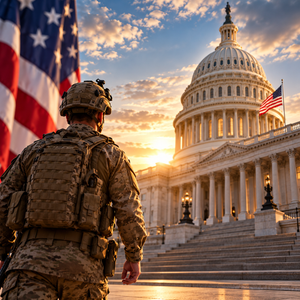
- Largest Caucus in Eight Years: The 119th Congress opened with 100 military veterans among its 535 members, marking the highest level of prior-service representation on Capitol Hill since 2017.
- The Post-9/11 Generational Shift: Nearly one-third of all veteran lawmakers began their military service after January 1, 2000, signaling a decisive shift in political power to the post-9/11 generation.
- Historic Diversity Milestones: A record-breaking nine women veterans were elected, representing the largest cohort of female prior-service lawmakers in U.S. history.
- Active Bipartisan Engines: The House’s bipartisan For Country Caucus expanded to 37 members, co-chaired by Reps. Jake Ellzey and Don Davis, to spearhead cross-partisan national security legislation.
Moving from the Battlefield to the Halls of Governance
For decades, the decline of veteran representation in Congress has been a source of concern. From a peak in the
mid-1970s—when over 70% of lawmakers had military backgrounds—prior-service representation steadily dwindled to below 20%. Hyper-partisanship grew in direct proportion to this decline, as the unifying experience of military service was replaced by partisan tribalism.
The seating of the 119th Congress in 2025 and its governing term throughout 2026 has delivered a critical counter-offensive. Bolstered by grassroots recruitment, national veteran-led PACs, and a public that overwhelmingly trusts military veterans to put country before party, prior-service lawmakers have achieved a significant resurgence. This post-election results scorecard details the specific metrics, partisan breakdowns, and generational shifts defining this new governing class.
The Veteran Representation Scorecard: Seating the 119th Congress
At the opening of the 119th Congress, the total number of veterans on Capitol Hill reached 100, representing about 18.7% of the legislature. While this number adjusted after JD Vance and Michael Waltz resigned for executive roles, prior-service lawmakers remain a powerful, cohesive bloc.
The partisan divide within this caucus remains heavily weighted toward one side of the aisle, though veteran-led bipartisan coalitions continue to wield outsized influence. The core partisan and chamber distributions are structured as follows:
- Total Veterans Seated: 100 (Adjusted to 98 following early executive departures)
- Chamber Distribution: 20 Senators and 80 Representatives (Adjusted to 19 Senate and 79 House)
- Partisan Breakdown: 72 Republicans and 28 Democrats
- Top Represented States: Texas leads with 11 veteran lawmakers, followed by Florida with 9, and California with 7.
While veterans comprise only about 6% of the U.S. adult population, their presence on Capitol Hill remains more than triple their societal proportion. This disproportionate share highlights the persistent trust voters place in prior-service candidates.
Branch of Service and Generational Dynamics
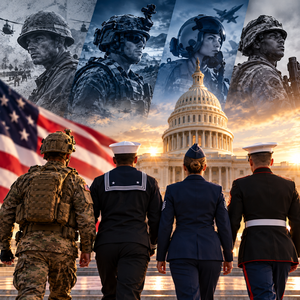
The prior-service caucus is not a monolith. Its members reflect distinct branches of military service, co
mbat eras, and operational backgrounds:
- U.S. Army: 46 veterans (including National Guard and Reserve officers)
- U.S. Navy: 25 veterans
- U.S. Air Force: 16 veterans
- U.S. Marine Corps: 13 veterans
A massive generational shift is transforming priorities. For years, the veteran caucus was dominated by draft-era veterans of the Vietnam and Cold War eras. In the 119th Congress, the post-9/11 generation has officially taken the helm. Thirty-one veteran lawmakers began service after January 1, 2000, bringing firsthand experience from the Global War on Terrorism and modern VA transitions.
Conversely, only 21 veteran lawmakers began military careers prior to 1980. This generational transition is critical. Post-9/11 veterans focus on modern operational readiness, cyber warfare, military childcare, and systemic reforms to VA systems.
Bipartisan Levers of Power: The For Country Caucus
The true value of veteran leadership on Capitol Hill lies in its unique capacity to bridge hyper-partisan divides. To turn this collective background into active governing power, veteran lawmakers have rallied around structured, cross-partisan coalitions. The most prominent of these is the House’s bipartisan For Country Caucus, which expanded its ranks to 37 active members at the start of the 119th Congress.
Co-chaired by Rep. Jake Ellzey (R-TX) and Rep. Don Davis (D-NC), this caucus requires all members to take a pledge of civility and collaborative governance. The group’s leadership includes vice-chairs Chris Deluzio (D-PA), Nick LaLota (R-NY), Troy Downing (R-MT), and Herb Conaway (D-NJ). Working with Senate allies like Roger Wicker (R-MS), Jack Reed (D-RI), Todd Young (R-IN), and Mark Kelly (D-AZ), this caucus acts as a primary legislative engine to secure vital military quality-of-life provisions.
Strategic Implications for Veteran Policy in 2026
With 98 veterans active through 2026, the strategic focus on military family policy must remain sharp. Prior-service lawmakers must use their power to hold agencies accountable and defend the unwritten covenant.
The primary legislative battles for 2026 center on military quality of life and healthcare access. The veteran caucus is uniquely positioned to enforce strict oversight on privatized military housing, expand mental health initiatives to combat active-duty and veteran suicide, and protect mail-in voting access for overseas service members. It is not enough for these lawmakers to have served; they must leverage their committee assignments to deliver measurable improvements for those still in uniform.
Call to Action: Holding Our Veteran Leaders Accountable
American voters elected these veterans because we trusted them to put principles before politics. Now, w
eDo we have B-roll that would work with this sound? Do we have anyone on the inversion table? That’s the one you flip upside down on? Maybe we cycle between inversion, massage chairs, red light, then cold plunge a few seconds of each must treat their legislative records with the same operational scrutiny we apply to any public official. To ensure our prior-service lawmakers are delivering on their oaths, every veteran advocate and military family voter must execute this plan:
- Audit Committee Work: Track whether your veteran representative is utilizing key committee assignments to sponsor and pass defense and quality-of-life legislation.
- Monitor Cross-Partisan Votes: Review how often your representative participates in bipartisan coalitions like the For Country Caucus to pass meaningful bills.
- Demand Written Accountability: Contact your representative’s office directly to ask where they stand on critical family issues, including housing contractor oversight, spouse employment tax credits, and the expansion of the Basic Needs Allowance.
The uniform may be off, but the obligation to serve continues. By holding our veteran leaders to the highest standards, we ensure that the “Service Wave” truly translates into enduring governing power.
Sources
- Military Times – Breaking Down the Number of Veterans in the 119th Congress:
https://www.militarytimes.com/news/pentagon-congress/2025/01/02/breaking-down-the-number-of-veterans-in-the-119th-congress/ - Military Officers Association of America (MOAA) – Congress Opens Session with More Veterans:
https://www.moaa.org/content/publications-and-media/news-articles/2024-news-articles/recommended-reads/congress-will-open-next-session-with-more-veterans-than-2-years-ago/ - Pew Research Center – The Changing Face of Congress in Seven Charts:
https://www.pewresearch.org/short-reads/2025/03/03/the-changing-face-of-congress-in-7-charts/ - With Honor Action – Bipartisan Veteran Leadership and Legislative Initiatives:
https://withhonor.org/about/
