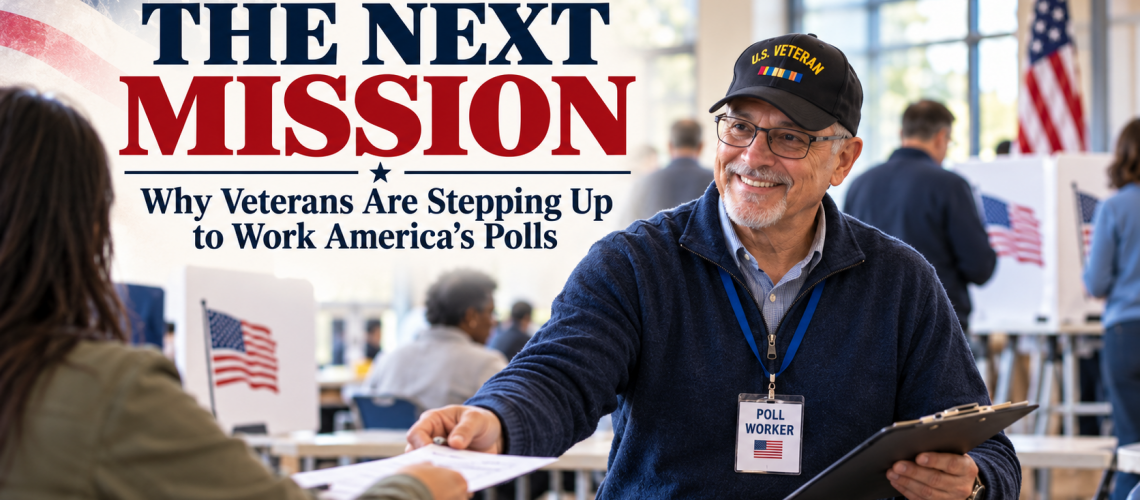
For veterans accustomed to serving a mission larger than themselves, Election Day offers another form of public service: helping local election officials operate polling places accurately, professionally and according to law.
Across the United States, elections depend on temporary election workers who set up voting locations, check in voters, issue ballots, assist voters with election equipment and carry out closing procedures. The U.S. Election Assistance Commission says roughly one million poll workers are needed for a presidential general election, and election offices have continued to make recruitment and retention a priority.
That workforce is increasingly drawing veterans and military families.
From Military Service to Community Service

Vet the Vote, a nonpartisan initiative led by We the Veterans and Military Families and supported by a national coalition of organizations, recruits veterans and military family members to serve as poll workers.
The Department of Veterans Affairs reported in July 2026 that more than 165,000 veterans and military family members had answered the initiative’s call since its 2022 launch. We the Veterans currently reports more than 164,000 recruits. Vet the Vote says participants have come from four out of every five U.S. ZIP codes.
The initiative is seeking additional volunteers for the 2026 midterm elections.
The work is deliberately nonpartisan. Poll workers are not campaign representatives, political observers or advocates for candidates. They work under state and local election authorities and are expected to administer established election procedures regardless of their personal political views.
That distinction is central to the job.
What Poll Workers Actually Do
There is no single national poll-worker job description because American elections are administered primarily by state and local governments.
Depending on the jurisdiction and assignment, election workers may prepare polling locations, check voters against registration records, issue ballots, explain voting procedures, assist voters with voting equipment, manage lines, document problems and complete required procedures when polls close.
Rules governing eligibility, political affiliation, residency, age, training and duties also vary significantly by state.
The Election Assistance Commission maintains a compendium of state poll-worker requirements covering the 50 states, District of Columbia and several U.S. territories. Those requirements are established through state statutes, regulations and local election procedures rather than a single nationwide set of rules.
That means poll workers do not decide how an election should operate while they are working. Their job is to follow the procedures established for their jurisdiction.
Why Veterans Are Being Recruited
Veterans are one of several groups election administrators and civic organizations are attempting to recruit into the election workforce.
Military experience can involve working within detailed procedures, functioning as part of a team, handling equipment, communicating with members of the public and remaining focused during long or stressful operations. Those experiences can translate well to some of the practical demands of election work.
But military experience does not replace election training.
Poll-worker training requirements differ across states and jurisdictions. The Election Assistance Commission reports that training may address voter check-in procedures, accessibility, voting equipment, election-day scenarios and differences between early voting and Election Day operations. Local officials frequently provide jurisdiction-specific instruction because election laws and equipment vary.
Accessibility is particularly important. Federal laws, including the Help America Vote Act, establish requirements intended to make voting accessible to voters with disabilities, while election officials provide additional training and procedures for implementing those protections locally.
Election Work Requires Political Detachment
The most important qualification may be one that has little to do with military experience: willingness to follow the rules impartially.
A polling place is not a campaign venue.
Election workers interact with voters with different political beliefs, backgrounds and circumstances. Their responsibility is to administer the voting process established by law and by their election office.
That can include situations where a voter has a registration problem, requires an accessible voting method, needs help understanding the process or must use a procedure such as a provisional ballot under applicable state law.
The worker’s personal opinion about the voter, candidate or election outcome is irrelevant to that responsibility.
For veterans accustomed to separating personal views from assigned duties, that expectation may feel familiar. But every poll worker, veteran or civilian, is held to the requirements of the jurisdiction in which they serve.
A Workforce That Still Needs People
Poll-worker shortages are not simply an Election Day inconvenience.
The Election Assistance Commission has warned that inadequate staffing can contribute to longer lines, fewer available polling locations and confusion for voters. Recruitment has therefore become a continuing concern for election administrators.
The workforce is also aging.
According to the EAC, fewer than 17 percent of poll workers serving during the 2024 election were younger than 40. Federal and local election officials have responded with recruitment campaigns aimed at students, younger adults and other potential workers who could help build the next generation of election staff.
Veterans and military families represent one part of that broader effort.
Poll Workers May Be Paid, but Compensation Varies Widely
Election work is often described as volunteering, but many jurisdictions compensate poll workers.
There is no standard national rate.
An EAC review found substantial differences among states and localities. Some establish minimum compensation, some leave payment amounts to local election officials, and some permit workers to decline compensation and serve as volunteers. Election Day assignments can also be lengthy, sometimes exceeding 14 hours when setup and closing responsibilities are included.
Anyone considering the job should therefore check directly with their local election office rather than relying on a national estimate of what poll workers are paid.
How Veterans and Military Families Can Get Involved
The process generally begins with the local election authority.
The Election Assistance Commission maintains a national poll-worker information portal that directs prospective workers toward state and local requirements. Vet the Vote also connects veterans and military family members with election offices seeking workers.
Applicants should expect requirements to differ by location. Depending on the jurisdiction, those requirements can include residency or voter-registration qualifications, minimum age requirements, training sessions, political-party representation rules or other statutory conditions.
The important point is that signing up is only the beginning. Election officials determine who is appointed, what training is required and what duties each worker performs.
Service After Service
Veterans do not need to agree politically to work together at a polling place.
In fact, the job requires the opposite approach: following the same procedures regardless of who appears on the ballot or which candidate a voter supports.
That makes poll work a distinctive form of civic service.
Veterans who choose to participate are not being asked to determine the outcome of an election. They are being asked to help their communities administer the process by which voters determine that outcome.
For people whose military careers were built around responsibility, procedure and service, working the polls can provide another place to put those principles into practice.
Sources
U.S. Election Assistance Commission, Become a Poll Worker. EAC Poll Worker Information
U.S. Election Assistance Commission, Election Worker Recruitment, Training, Retention, and Evaluation. EAC Election Worker Report
Department of Veterans Affairs, “Veterans and Military Families Answer Call to Staff Polls,” July 1, 2026. VA News
Vet the Vote. Vet the Vote
U.S. Election Assistance Commission, Voting Accessibility. EAC Voting Accessibility
